Showing posts with label Flower of Month. Show all posts

Saturday, 15 December 2018

Lisianthus - Flower of the Month - December

Lisianthus

This flower has its roots in the Wild West and has come to Europe all the way via Japan. Consumers can read all about this natural beauty in the Flower Agenda at Funnyhowflowersdothat.co.uk. Even with its delicate appearance, it is quite robust, lisianthus is rather well known but hardly celebrated. This magnificent flower deserves better praise, which can easily be done by presenting them in a special way.   
Lisianthus’ origin 
The lisianthus originates from North America where it grows in desert riverbeds and in prairie regions. In the states of Texas, Nebraska, Nevada and Colorado they call this plant prairie gentian. In the 1930s Japanese growers crossed the prairie gentian, laying the foundations for today’s range. The lisianthus is sometimes called Eustoma, which is the official scientific name.  
Lisianthus shapes and colours 
This flower is mostly seen in white and purple, but there is an enormous choice of colour available: the lisianthus comes in white, green, blue, pink, lilac, purple and salmon hues. Some flowers even have petals with multiple colours. The lisianthus also comes in many shapes: single and double flowered, large and small flowered and even with fringed petals.  Apart from being colourful, lisianthus petals are also very soft and delicate.   

Care tips for customers

  • Select a clean vase and fill it with tap water at room temperature.
  • Add cut flower food to the water for a longer vase life. This has a very positive effect on the vase life for lisianthus in particular.
  • Cut or trim the stems diagonally by 3 to 5 cm with a clean sharp knife or secateurs.
  • Make sure there are no leaves hanging in the water.
  • Do not place lisianthus in a draught, in full sun or near central heating.
  • Regularly top the vase up with tap water; lisianthus flowers drink a lot because they have thin petals, as a result of which they evaporate a lot of moisture.
  • Don’t place lisianthus near a fruit bowl. Fruit emits ethylene gas which will cause the flowers to age more rapidly.
Lisianthus symbolism 
The lisianthus may have a soft and delicate appearance, but it is sturdy and has powerful symbolism attached to it:  this flower represents appreciation, gratitude and charisma. That makes it the perfect candidate for a gift bouquet from someone else… or for yourself, of course!   


More inspiration and information 
Consumers will see the lisianthus feature on Funnyhowflowersdothat.co.uk and will learn to appreciate their beauty and learn about all their stories.  
We use Lisianthus in many of our wedding designs (see the right side bar). To give you some inspiration here are a sample
Shower bouquet

Bridal posy

Mother of bride corsage

Natural style buttonhole

If you are looking for wedding ideas for this beautiful flower come and visit us at The Studio and chat through your options.

Sandra

Friday, 13 April 2018

Flower of the Month April - Gerbera


Flower of the Month April - Gerbera

In April we mark Easter and the arrival of new life. The perfect setting for a colourful flower. With its cheerful appearance, the gerbera is the ideal candidate for some extra celebrations this month. Consumers can read all about this versatile flower at Funnyhowflowersdothat.co.uk. 
Origin of the gerbera
The gerbera is an unscented flower which is part of the Asteraceae family. It originates from South Africa, Asia, South America and Tasmania. Some 900 million gerberas a year are produced in the Netherlands with 600 different varieties of colour, shape and size. She’s one popular lady!


The gerbera’s colours and shapes
When you think of gerberas, you think of colour! The gerbera’s basic colours are white, red, yellow, pink, purple, orange and green. The flower is also available bicoloured, multicoloured and in various shades derived from the basic colours. The flower’s beautiful heart can be black or green. In other words: there’s plenty of choice when it comes to colour. The shape is always cheerful: single and double flowered, pom-pom and spider shapes. Have you noticed that when a child draws a flower, it’s always in the shape of a gerbera?    

Caring for the gerbera
  • Trim the stem diagonally with a sharp knife.
  • Use a clean (glass) vase and fill it with approx. 7 cm of tap water at room temperature. Use cut flower food for a mixed bouquet.
  • Ensure the right ambient temperature (max. 20 °C).
  • Do not place gerberas in a draught, in full sun or near central heating.
  • Regularly top the vase up with tap water. 
Symbolism of the gerbera
The gerbera is the birth flower. Its presence means: you make everything more beautiful! With its colourful and sunny appearance it makes your home loads more cheerful and welcoming straightaway.
Thanks to Flower Council of Holland for all the above information.
As a wedding florist I create many bouquets and table centrepieces with gerberas. There does seem to be some florists however, that won't use them. Fear not, if you love gerbera, whatever another florist may have said, they do last the day and will create striking displays for your wedding in a wide range of colours.


If you love them as much as I do, please get in touch and we can talk through options and colours to create fabulous displays to WOW your guests.


I have many designs in my portfolio and happy brides to prove they are as versatile as any other beautiful flower.

Sandra xx


Friday, 6 October 2017

Chrysanthemum - Flower of Month - October

Chrysanthemum: in the Flower Agenda all October

October will have a golden glow this year, thanks to the radiant chrysanthemum. It doesn’t only bring warmth and colour to your interior, but also good luck! Consumers can read all about this fabulous bloom at Funnyhowflowersdothat.co.uk. Introduce your customers to the chrysanthemum!
The origin
The chrysanthemum has been incredibly popular in Asia for centuries. The flower originates from China and Japan, where they fell in love with it immediately. The chrysanthemum arrived in Europe in around 1700. The chrysanthemum’s name derives from the Greek: chrys (gold) and anthemon (flower). Originally you could only enjoy the chrysanthemum in golden yellow.
Colours and shapes
You might almost forget that the chrysanthemum was originally yellow, since the flower is now available in an incredibly wide range of colours. Opt for colour and enrich your home with chrysanthemums in warm gold, bronze or deep orange tones. Or go for subtle and calm with chrysanthemums in soft shades of white, pink or purple.
This fantastic flower also comes in different varieties: you can release your inner stylist with spray, disbudded or Santini chrysanthemums. On the latter, the flowers are branched on the stem and are far more compact, to give a unique look! And if that wasn’t choice enough, there are also many different flower shapes: from single to double flowered and from spider to pom-pom shape.

Caring
  • Provide a clean vase and clean water at room temperature.
  • Trim the stem diagonally with a sharp knife.
  • Remove the leaves so they’re not hanging in the water.
  • Add cut flower food.
  • Refresh the water every five days and top it up regularly.
  • Don’t place your flowers in full sun, near a heater, close to a fruit bowl or in a draught.
Symbolism
The stylish chrysanthemum brings both infinite colour into your home as well as a healthy dose of joy, since this flower represents health and happiness. It doesn’t just look good on your own sideboard, but also makes a lovely gift!

Thank you to Flower Council of Holland for the information

Don't dismiss the humble Chrysant, there are beautiful varieties out there in all colours and many with a vintage feel to them which is still a very popular style.
They are also long lasting and budget friendly, so win win in designs that will just last and last, giving excellent value for money. A great pick me up and treat at any time of year.

We always have some in stock, ask to see the latest varieties available.

Sandra X


Friday, 1 September 2017

Flower of Month - September - Exotics

Exotic Flowers: In the September Flower Agenda

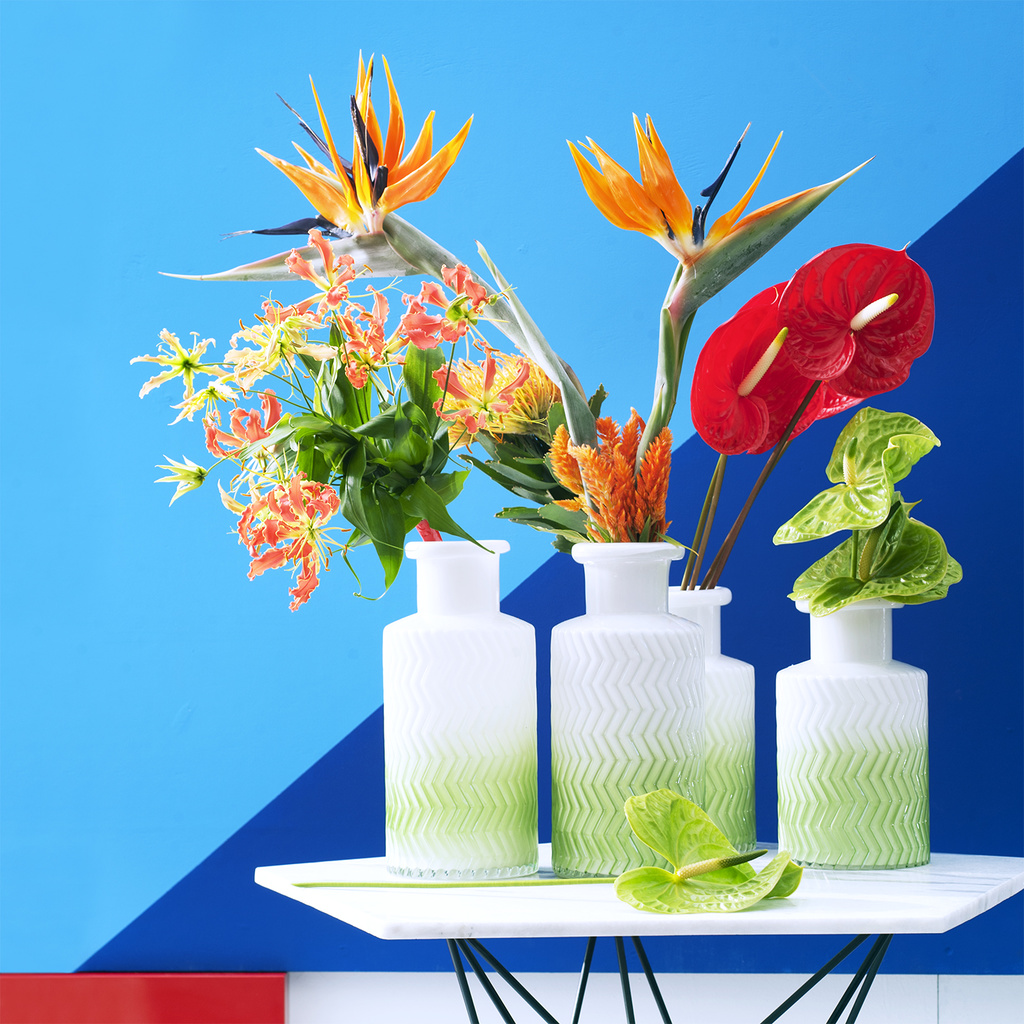
This September we're not going to be focusing on one flower, but three! Strelitzia, Gloriosa and Anthurium are each eye-catching characters that carry you off to sun-soaked destinations. You can read all about the Strelitzia, Gloriosa and Anthurium at Funnyhowflowersdothat.co.uk
The origin of Strelitzia, Gloriosa and Anthurium
In september staan de exoten op de BloemenAgendaThe anthurium originates from Brazil, Ecuador, Peru, Colombia and Venezuela. The French botanist Eduard André discover the flower in Colombia and Ecuador in 1876. In the wild, Gloriosa - a cousin of the lily family - clambers upwards in India and southern Africa. The official name is Gloriosa rothschildiana, named after zoologist Lionel Rothschild. Strelitzia originates from South Africa, and was transported to many countries in the 18th century. That’s also how it acquired its name: the wife of the English King George III, Charlotte of Meckelenburg-Strelitz, had a great love for flowers and plants,  and so this remarkable flower was named after her.  
Colours and shapes of Strelitzia, Gloriosa and Anthurium
Did you know that the anthurium’s flower is actually the spike (the ‘finger’ sticking out of the bract) and not the brightly coloured bract itself? But secretly we all love the bract. This comes in gleaming white, red, pink, purple, orange, green and multiple colours. Gloriosa combines a delicate fresh green stem with elegant chartreuse yellow stamens that dance at the bottom (!). Above that grow six undulating flaming petals which open out to you during the flowering. There are two types: short with a bare stem, and a bit taller with leaves and branches. Strelitzia’s simple stem bearing a comb made up of elegant open orange sepals with two or three blue petals ensures that you are not likely to overlook this beauty. 


Caring for Strelitzia, Gloriosa and Anthurium
  • Trim the stem diagonally with a sharp knife.
  • Use a clean (glass) vase and fill it with approx. 7 cm of tap water at room temperature. Use cut flower food for a mixed bouquet.
  • Ensure the right ambient temperature (max. 20 °C).
  • Do not place exotics in a draught, in full sun or near central heating.
  • Regularly top the vase up with tap water. 

Symbolism of Strelitzia, Gloriosa and Anthurium
Thanks to its appearance and origin, the anthurium symbolises exotic beauty. The name anthurium is derived from the Greek words 'anthos' and 'oura', which mean ‘flowering’ and ‘tail’. The Gloriosa's flowers represent ambition and success: the ideal gift for someone starting a new job or experiencing new beginning in some other way. Strelitzia is seen as the flower of freedom, and also represents immortality. This special symbolism deserves a good story to go with it.

They make excellent corporate designs, adding WOW factor with unusualness and in a warm environment they last well.


Not used extensively for weddings, but for a hint of the tropical, why not!


To talk through using these flowers for any of your displays both corporate or for weddings get in touch with Sandra who can help and advise you on availability.

Sandra x


Friday, 4 August 2017

Hydrangea - Flower of the Month - August

The Hydrangea - in the Flower agenda thoughout August

We're firmly hanging onto that summer feeling with the hydrangea. This natural mood booster can bring the sunshine inside, all year round. With its robust appearance, the hydrangea is like a holiday in a vase. 

Consumers can read all about this seasonal beauty in the Flower Agenda courtesy of our friends at The Flower Council of Holland, find more information on their consumer website Funnyhowflowersdothat.co.uk.

Origin of the hydrangea

The no-nonsense hydrangea’s name comes from ‘hydro' (water) and ‘angeion’ (pitcher) because the hydrangea’s shape is reminiscent of an old water pitcher… although you need quite a lot of imagination to see it! The flower, which originates from Asia and South America, came to Europe on the first Dutch East Indies Company ships.

The hydrangea’s colours and shapes

In the first half of the year you see red, pink, purple, white, green and blue hydrangeas, as well as hydrangeas which combine several colours. In the second half of the year there are the ‘colour-changed’ flowers. These hydrangeas have a green/dark red/brown tone and are good for drying. These are actually flowers that the grower has left to develop in the greenhouse. There’s also plenty of choice when it comes to shape. You can choose single or double flowered varieties, globe-shaped hydrangeas, hydrangeas with small flowers in the middle and large petals on the edge (edge bloomers) or hydrangeas with a plume shape.

Care tips for customers


•    Select a clean vase and fill it with tap water at room temperature.
•    Add cut flower food to the water for a longer vase life.
•    Cut or trim the stems diagonally by 3 to 5 cm with a sharp and clean knife or secateurs.
•    Make sure there are no leaves hanging in the water.
•    Do not place hydrangeas in a draught, in full sun or near central heating.
•    Regularly top the vase up with tap water; hydrangea flowers drink a lot because they have thin leaves and thin petals, as a result of which they evaporate a lot of moisture.
•    Don’t place hydrangeas near a fruit bowl. Fruit emits ethylene gas which will cause the flowers to age more rapidly.


A fabulous bouquet with hydrangeas

Bouquet recipe with hydrangeas The hydrangea is a flower you can’t get enough of. Its globe shape, the tiny flowers that all bloom idiosyncratically, the sometimes almost unnatural colours that vary with the seasons: the hydrangea keeps us under its spell. Combined with the right colours and supporting cast it creates a wonderful spectacle that looks like it’s come straight from a fairy story. 
You will need:
• Hydrangea
• Delphinium
• Rose
• Carnation
• Dahlia

Hydrangea symbolism

Alongside the flower’s magnificence, there’s another good reason to buy hydrangeas: they symbolise gratitude, grace and beauty. They also project abundance because of the lavish number of flowers and the generous round shape. The hydrangea’s colours symbolise love, harmony and peace so it’s perfect for use in floral work for weddings, funerals or birthdays.

Inspiration and information

Inspiring images of every flower in the Flower Agenda have been produced in line with the Horticulture Sector Trends 2017 (Groenbranche Trends 2017). These trends are a translation of what our consumers are interested in at the moment and are specifically aimed at the horticulture sector for use both indoors and outdoors.
If you would like to find out more about the Flower Agenda click here.

Hydrangeas are fabulous flowers for weddings!! They may be expensive per head but boy do those heads go a long way. Whether thats as a single head with sprigs of gyp for a bridesmaid bouquet

As smaller sections to go into a fabulous flower crown


To fill these gorgeous candelabra table centrepieces


Or to fill out a large design fit for a stunning mantlepiece


or to frame your ceremony space.


We love working with hydrangea and can work with all colours as and when available. 
If you want to include this stunning flower in your designs come and speak to us about your dreams and style and we can make that happen

Sandra X


Friday, 7 July 2017

Sunflower - Flower of the month - July


The sunflower is in the Flower Agenda in July

Summer is in full swing. And so we’re letting the queen of the summer flowers shine this month. With its optimistic appearance, the sunflower is the ideal candidate for some extra celebrations this month. Consumers can read all about this cheerful flower at Funnyhowflowersdothat.co.uk. 
The sunflower’s origin
The sunflower originates from North and South America. Native Americans ate the flower’s seeds with beans, sweetcorn and squashes, and people and animals still enjoy sunflower seeds today. Did you know that the sunflower’s official name is Helianthus? A combination of the Greek words ‘helios’ (sun) and ‘anthos’ (flower).

The sunflower’s colours and shapes
We particularly know the sunflower as a yellow beauty, but there are also orange, brown, cream and dark red versions. There’s also plenty of variety when it comes to shape: there are sunflowers with large or small flowers, with a single row of petals or with multiple rings of petals. Whichever you choose, sunflowers undoubtedly guarantees a healthy dose of summer mood.
Caring for sunflowers
•    Trim the stems diagonally.
•    Remove surplus leaves from the stems.
•    Place the flowers in a clean vase - preferably glass - with tap water at room temperature.
•    Add some cut flower food.
•    Regularly top the vase up, because sunflowers are thirsty.
•    Place the vase in a cool spot away from the fruit bowl and not in full sun.
•    Allow for the weight of the sunflowers, so choose a sturdy vase. 

Sunflower symbolism
The sunflower often symbolises the sun and love. In Greek mythology the nymph Clytia fell head over heels in love with the sun god Apollo. Although Clytia was very beautiful, Apollo did not reciprocate her love. As a result Clytia died of a broken heart, was transformed into a sunflower and therefore constantly follows the sun in order to be able to see her sun god. So this cheerful flower comes with a very romantic but tragic love story…
Love Sunflowers? Want them as part of your wedding? Not sure how? We have created several wedding's with Sunflowers at the heart of them.


For more ideas on how to style your wedding around this glorious flower search in labels on the right for 'Sunflowers'. Alternatively for more details give us a call and book in for a consultation where we can go through your options.

Sandra x 


Friday, 23 June 2017

Flower of the month - June - Peony

The peony -in the Flower Agenda throughout June

It’s June, and that means it’s time for the gorgeous peony. This beauty will be shining in many vases this month, but can also be seen extensively in bridal bouquets and striking centrepieces. Consumers can read all about the phenomenal peony at Funnyhowflowersdothat.co.uk. 
Introduce your customers to the peony!
The peony’s origin
We have been enjoying the magnificent peony in Europe since 1784. In China they had fallen under its spell long before that. There the peony was cultivated not only for its flowers, but particularly for its roots. According the Chinese it could be used to reduce fever and clot blood. But we don’t recommend putting the peony in your mouth - stick to enjoying its beauty with your eyes.
The peony’s colours and shapes
Anyone who falls for the charms of the peony is in luck: there are more than 1000 varieties available in all sorts of shapes and colours. They come with a single row of petals, or with semi-double or double flowers. There is also ample choice in terms of colour: the cheerful  peony comes in pale yellow, romantic white, candy pink or dark red. And the fragrance of peonies is particularly appealing and beautifully sweet!

Caring for peonies
  • Trim 5 cm off the stem diagonally with a sharp knife.
  • Use a clean vase and fill it with fresh water.
  • If your peonies are thirsty top up the vase.
  • Don’t place the vase in a draught, in full sun or near the fruit bowl.
Peony symbolism
The peony represents love, happiness and health, amongst other things. It’s no surprise that the peony is a popular guest at spring weddings. But it’s not just lovebirds that are attracted to this flower. Surely we all enjoy bringing a big bunch of positivity and love into our home?


More about the peony
Consumers can also find special DIY craft projects involving the gorgeous peony at Funnyhowflowersdothat.co.uk. Got a wedding, birthday or other celebration coming up? Then try making your own over-the-top peony chandelier!

Inspiration and information
Inspiring images of every flower in the Flower Agenda have been produced in line with the Horticulture Sector Trends 2017 (Groenbranche Trends 2017). These trends are a translation of what our consumers are interested in at the moment and are specifically aimed at the horticulture sector for use both indoors and outdoors. If you would like to find out more about the Flower Agenda click here.

These are wonderful late spring/early summer flowers and are well worth having in your displays at this time of year.
Are you getting married? Would love them in your bouquets? We can stock many varieties in season, just let us know your colour scheme and we can source the best varieties for you.


Sandra x

Friday, 5 May 2017

Carnation - Flower of the Month - May

The carnation:Flower of the Month - May

A new month, a new flower in the spotlight. This month the vintage carnation takes centre stage. With its many forms and high quality, it’s a flower to adore. Consumers can read all about this versatile beauty at Funnyhowflowersdothat.co.uk. 
The carnation’s origin anjer2017-01
The original birthplace of the carnation is on the coast of the Mediterranean. The popularity of the flower goes back many centuries; for example, the Romans were already making wreathes and fresh eau de toilette out of carnations. The flower can also be regularly seen in religious paintings as a symbol of the Virgin Mary and to symbolise the suffering of Christ. The Latin name for the carnation is Dianthus, derived from Dios (God) and anthos (flower). That means that the carnation is a divine flower! 
Colours and shapes of the carnation
Green, deep purple, dark red, fluorescent yellow, champagne, soft orange, salmon pink, white or combinations of colours: the carnation offers a magnificent array of colours. But that’s certainly not the only remarkable thing about this flower. For example, are you familiar with the various shapes? There are carnation with a single flower, and there are spray carnations. The carnation also has eye-catching petals, with rounded, serrated or fringed edges. So it's no surprise that the carnation is a fantastic lead performer or support act in any vase. 


Caring for carnations 
  • Make sure the vase is clean.
  • Fill the vase with water and cut flower food.
  • Remove the bottom leaves.
  • Trim the stems.
  • Keep carnations away from direct sunlight and ripening fruit.
Carnation symbolism
The carnation symbolises passion, longing and romance. That's why Renaissance painters in the 15th and 16th century chose this flower to appear in their engagement scenes. And nothing has changed in that regard: the carnation is still an appropriate gift for demonstrating passionate love. Or to revive the passion in your relationship. If that should be necessary…  
Renaissance painters in the 15th and 16th century chose the carnation with love to appear in opulent paintings. A bouquet with these romantic, colourful flowers results in a blooming still-life you just can’t keep your eyes off.  

Carnations we feel have a bad reputation. They ARE budget friendly and yes some colours have been around since forever BUT the new varieties, colours and scents that are being produced really do make this a flower coming back to designs. They do make a good filler and work well with a variety of styles, and don't look out of place in bouquets if used right.

So go on, give this gorgeous flower another look, it deserves it!
With thanks too https://www.flowercouncil.co.uk for the information
Sandra X

Friday, 14 April 2017

Gerbera - Flower of the Month - April

Gerbera in the April Flower Agenda

In April, we mark Easter and the arrival of new life: the perfect occasion for a colourful flower. With its cheerful appearance, the gerbera is the ideal candidate to make celebrations extra special this month. Consumers can read all about this versatile flower at Funnyhowflowersdothat.co.uk. 
 
Origin of the gerbera
The gerbera is an unscented flower which is part of the Asteraceae family. It originates from South Africa, Asia, South America and Tasmania. Some 900 million gerberas a year are produced in the Netherlands with 600 different varieties of colour, shape and size. She’s a very popular lady!
The gerbera’s colours and shapes 
If you think of gerberas, you think of colour! The gerbera’s basic colours are white, red, yellow, pink, purple, orange and green. The flower is also available bicoloured, multi-coloured, and in various colours derived from basic primary colours. The flower’s beautiful heart can be black or green. In other words: there’s plenty of choice when it comes to colour! The shape is always cheerful: single and double flowered, pom-pom and spider shapes. Have you noticed that when a child draws a flower, it’s always in the shape of a gerbera?
Caring for gerberas 
  • Trim the stem diagonally with a sharp knife.
  • Use a clean (glass) vase and fill it with approx. 7 cm of tap water at room temperature. Use cut flower food for a mixed bouquet.
  • Ensure the right ambient temperature (max. 20 °C).
  • Do not place gerberas in a draught, in full sun or near central heating.
  • Regularly top the vase up with tap water. 
Symbolism of the gerbera 
The gerbera has no symbolic meaning, but why should that matter? With its colourful and sunny appearance it instantly makes your home a cheerful and welcoming place. Its presence means: you make everything more beautiful!
A few questions we get asked a lot about these gorgeous flowers

Question 1: Gerberas come in all sorts of colours, but how many different colours are there actually?

Gosh, there are so many you can't even count them… Gerberas really do come in hundreds of different colours. They can be single-coloured, but also multi-coloured. The gerbera's heart is also colourful; it can be green or black. The most popular colours are orange, yellow, red, purple, salmon, white, pink and bi-coloured.

Question 2: Gerberas can get quite large. What makes a gerbera 'standard' or 'mini'?

First some background: gerberas are part of the plant family Asteraceae and come in three types. These are: large-flowered varieties (standard gerbera), small-flowered varieties (mini gerbera) and specialties. If a gerbera has a diameter of between 6 and 8 cm, it is classified as a mini gerbera. A standard gerbera ranges between 9.5 and 13cm. There are also gerberas with a diameter of some 15cm, incidentally!

Question 3: My gerberas’ heads are drooping a bit. What can I do?

Let us give you the golden tip for perking them up!
  • Start by cleaning your vase thoroughly. Use bleach for this.
  • Put fresh water in the vase, but be careful: too much water is not good, since the stems can then start to rot.
  • Cut another piece off the bottom of the stems and then return the gerberas to the vase. They will be radiant again soon!

Question 4: Sometimes you see a box of gerberas stored upside down at the florist. Why is that?

Gerberas love light. If the light is coming from the right, they will grow to the right. If the light is coming from the left then… well, you can guess the rest. The end result is bent stems. Upside down in the box the gerberas are unable to grow towards the light. In this way your florist is preventing the gerbera stems from growing crooked. Gerberas with bent stems are difficult to use in bouquets or floral work.

8 vragen en antwoorden over de prachtige gerbera Mooiwatbloemendoen.nl
Question 5: With which other flowers do gerberas combine well?

Gerberas like to flirt with Fritillaria meleagris (also known as snake's head fritillary), asparagus, lilacs and roses. Another good combination is gerberas with freesias, chrysanthemums and Chaenomeles japonica. Need more inspiration? Ask your florist for advice on which flowers to use to make your own bouquet, or ask them to create an arrangement for you.

Question 6: In the past you saw gerberas with a wire in the stem. Why do you hardly see that nowadays?

That answer is easy: there’s no need any more! The wire was used to strengthen the stem. Nowadays the quality of gerberas is so good that this is no longer necessary. The gerbera remains nice and straight on its own.

Question 7: Gerberas are often used in bouquets. But can I also use them on their own, and if so how?

It's no surprise that gerberas are often used in bouquets. Their colour and shape simply means that they work well in conjunction with other flowers. But the gerbera is also very beautiful on its own. Try putting together a number of bottles, each containing a single gerbera .... guaranteed to provide a colourful spectacle!

Question 8: Are there gerbera plants?

There certainly are! There are gerbera plants for use both indoors and outdoors. You can even enjoy gerberas in the winter, thanks to the hardy garden gerbera.
Question 9: Can they be used for wedding flowers?
Absolutely!! They are our second most popular flowers (after roses). Many florists won't use them, there is a little bit of snobbery when it comes to these flowers, but we will!! And more importantly we love them!!


If you are looking for a bright and bold flower for your bouquet then gerberas are definitely a great choice. Ask us for more details or book a consultation to go through your options.

With thanks to Flower Council of Holland and Funny How Flowers Do That for content.

Sandra x