Tuesday, 17 April 2018

Flowers For You

A new way to buy flowers!!

I have a subscription service to deliver flowers fortnightly, usually on a Wednesday when the main fresh stock arrives, meaning the flowers will be as fresh as possible and therefore last you as long as possible.
The flower choice will be mine, but all seasonal beauties and in lovely colour palettes that will be different from the delivery before.

All flowers will be labelled with the florists name (you may know some of them by the latin or garden names) so you will be able to order any favourites another time. Any special care instructions will be added and flower food will be attached.
The stems will be kept as long as possible making it easier for you to arrange yourself in your own vases.


All flowers will come gift wrapped in a beautiful flower bag.

These purple and white flowers were delivery 1.


These I arranged in one of my vases to show the type of display you can achieve.
*Vases are available to purchase for an additional cost.


These are delivery 2 choice and all British blooms this time.


Again wrapped in cellophane for delivery,


and an example of the display you can create with them in a vase.


I also created this to show that if you are more adventurous and feel like creating a display for your coffee table this can achieved. 
Cube and foam may also be purchased.

Payments are monthly, some months have 2 deliveries, some 3. It is up to you whether you pay and receive the extra one. All flowers will be delivered fortnightly, usually on a Wednesday at a time convenient to me. Payment is each month, for however many months you want. You may miss months and start again at a later date. All flowers paid for upfront at the start of the month. No flowers delivered without payment.
Suitable as a treat for you or you can give as a gift to a friend, mum, daughter etc. Perfect for birthday presents. A small florist card can be added for gifts.
Each month must be to the same address.

Cost is £60. This is for 2 deliveries (if 3 deliveries that month £90).
** Discount for return of flower bag is £5 per usable bag. Taken off the next booked delivery.
2 bags returned £10 discount
Local Delivery is included within 10 miles radius of The Studio. Further afield will incur a delivery charge but will be discounted from our usual rates. POA.


If you need further details please get in touch


I look forward to hearing from you very soon

Sandra x

Friday, 13 April 2018

Flower of the Month April - Gerbera


Flower of the Month April - Gerbera

In April we mark Easter and the arrival of new life. The perfect setting for a colourful flower. With its cheerful appearance, the gerbera is the ideal candidate for some extra celebrations this month. Consumers can read all about this versatile flower at Funnyhowflowersdothat.co.uk. 
Origin of the gerbera
The gerbera is an unscented flower which is part of the Asteraceae family. It originates from South Africa, Asia, South America and Tasmania. Some 900 million gerberas a year are produced in the Netherlands with 600 different varieties of colour, shape and size. She’s one popular lady!


The gerbera’s colours and shapes
When you think of gerberas, you think of colour! The gerbera’s basic colours are white, red, yellow, pink, purple, orange and green. The flower is also available bicoloured, multicoloured and in various shades derived from the basic colours. The flower’s beautiful heart can be black or green. In other words: there’s plenty of choice when it comes to colour. The shape is always cheerful: single and double flowered, pom-pom and spider shapes. Have you noticed that when a child draws a flower, it’s always in the shape of a gerbera?    

Caring for the gerbera
  • Trim the stem diagonally with a sharp knife.
  • Use a clean (glass) vase and fill it with approx. 7 cm of tap water at room temperature. Use cut flower food for a mixed bouquet.
  • Ensure the right ambient temperature (max. 20 °C).
  • Do not place gerberas in a draught, in full sun or near central heating.
  • Regularly top the vase up with tap water. 
Symbolism of the gerbera
The gerbera is the birth flower. Its presence means: you make everything more beautiful! With its colourful and sunny appearance it makes your home loads more cheerful and welcoming straightaway.
Thanks to Flower Council of Holland for all the above information.
As a wedding florist I create many bouquets and table centrepieces with gerberas. There does seem to be some florists however, that won't use them. Fear not, if you love gerbera, whatever another florist may have said, they do last the day and will create striking displays for your wedding in a wide range of colours.


If you love them as much as I do, please get in touch and we can talk through options and colours to create fabulous displays to WOW your guests.


I have many designs in my portfolio and happy brides to prove they are as versatile as any other beautiful flower.

Sandra xx


Wednesday, 11 April 2018

Stock for sale (Vases, candlesticks and cubes)

As a florist I have all sorts of vases and containers to hire. Some prove more popular than others, so I have decided to sell off some stock to make room in The Studio. Below is a sample of items available to buy. (all containers WITHOUT flowers). Collect from The Studio or local delivery can be arranged.


Black (5) (and pink (6)) urns


Blue (and pink) candlesticks and Blue (and pink) pumpkin vases


Small conical vases


Crystal gem bowls (12)


Gold bottles


Lily vases
Clear: 40cm (4)
50cm (8)
60cm (10)
and
black 50cm (5)


Low Martini vases (5)


Mirror cubes

If you are interested in buying any of the above, please get in touch for prices. Only a small number of each available Numbers in (), extra discounts for buying all of each item.

Many other items available to hire. Whether with flowers or without for any occasion. See our main website 

Sandra XX


Tuesday, 10 April 2018

Add on gifts, Chocolates, teddies, balloons and vases

I know you know we send flowers as gifts.


But did you know you can add a variety of items as an add on?

Balloons, we have a selection,


Teddy bears, who can resist a cute bear?


And boxes of flower shaped chocolates.

New in: We can also send as a add on gift or arrange your flower in a range of glass vases. Save your chosen recipient from hunting around for the vase in the back of a cupboard, and treat them to a new one.
Various sizes and styles available. Speak to Sandra when you order your flowers today.


Surprise a loved on today with flowers and a range of other goodies.

Sandra xx


Monday, 9 April 2018

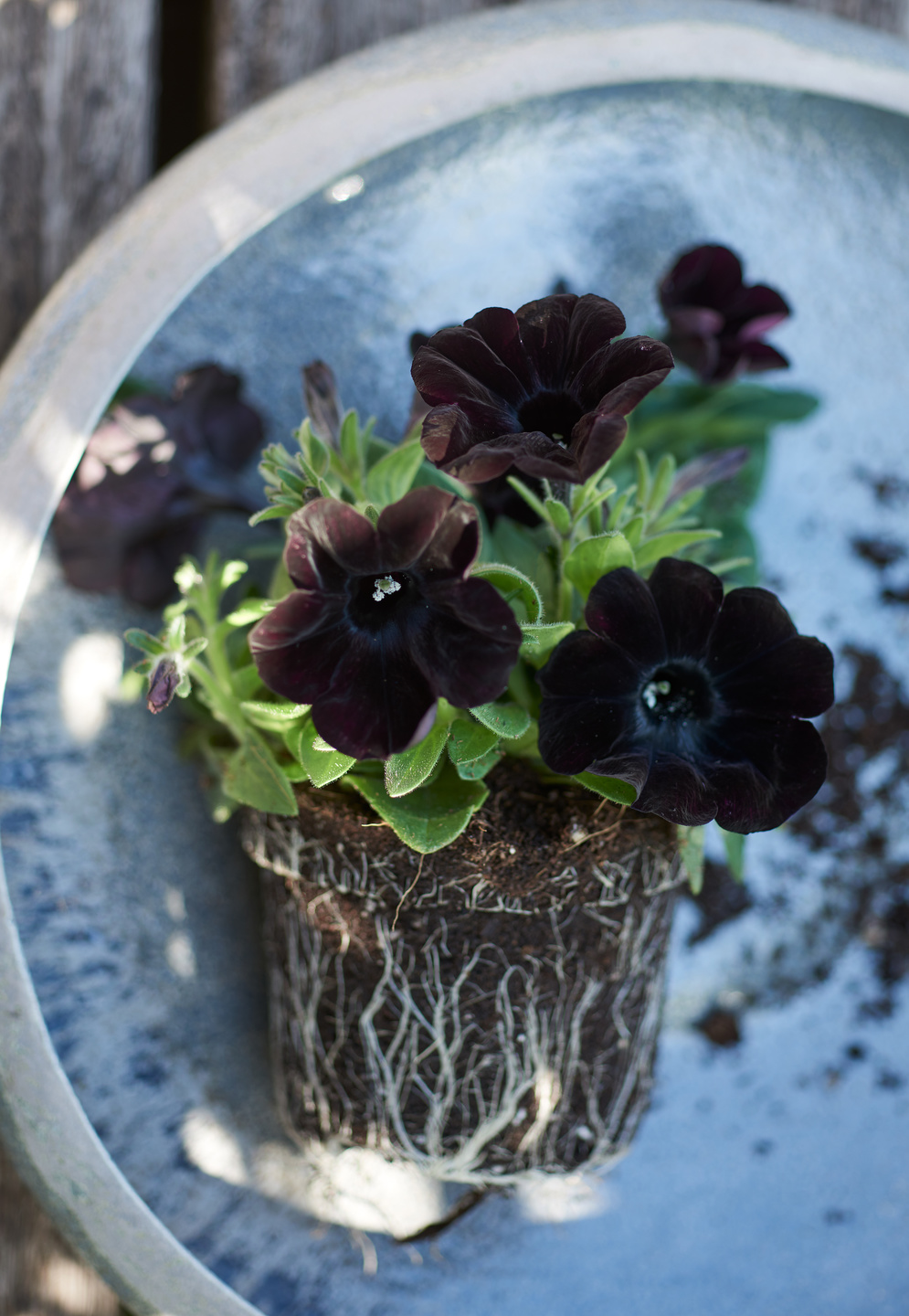
Garden Plant of the Month - Petunia


Garden Plant of the Month for April 2018: Petunia

The Petunia: easy care, lots of choice  
With its large trumpets the Petunia proclaims in all directions that spring really has sprung. This colourful summer annual has diverse uses: in hanging baskets, containers, sacks on the wall and troughs. And when it’s planted in a bed, the Petunia likes to shine amongst the groundcover in borders. It has staying power: if looked after properly, the Petunia will flower until the frosts arrive and will create a sea of flowers in the garden for all that time. 
Range 
Tuinplant van april 2018: Petunia Plain, spotted, striped, with single or double flowers, and that profusion of beauty in all the colours of the rainbow through to almost black - the choice of petunias is overwhelming, although they sometimes bear a different name. Well-known series such as Surfinia, Crazytunia or Cascadia hint at their specialism with their name: long stems, unusual flower shapes or a cloud of hanging flowers. 
Petunia trivia
• The plant is related to Nicotiana, the tobacco plant.
• The Petunia was given its name in 1789 by French botanist Antoine Laurent de Jussieu (1748-1836). He drew his inspiration from what he knew: at the time, ‘pétun’ was the local word for tobacco.
• Artist Georgia O'Keeffe made her breakthrough in 1925 with a Petunia painting. She had planted purple and blue petunias next to her summer home on Lake George, and adored them so much that she recorded the flowers in sensual close-ups that became a sensation. 
• Bees love the Petunia’s nectar, so that the plant brings lots of activity to the garden. 


Origin 
The Petunia originates from South America, where the plant grows in Brazil and Argentina. In the wild the plants often look much more rangy than the profusion of flowers that growers have managed to produce through crossbreeding. There are hundreds of hybrids available, and breeders keep producing new cultivars with new colours or shapes or which are - for example - better able to cope with rain. 

What to look for when buying
• Generally speaking, the larger the plant you buy, the greater the chance that it will be a successful bloomer.
• It’s particularly important for Petunias offered in very small pot sizes to check that the plant is rooted and shows signs of growth. These small  plants are usually grown from seed, the larger ones from cuttings.
• It’s important to keep the soil damp in order to prevent drooping.
• Remove yellowed leaves and wilted flowers from plants that have been on the shopfloor for a while, and ensure sufficient light in order to avoid stretching.
• As with all summer annuals, the earlier the Petunia finds a home for the summer, the better.
 
Care tips for consumers 
• Petunias like to be out of the wind in full sun.
• Keep the soil moist, water every day on sunny days, ensure drainage in pots and hanging baskets so that the roots don’t get too wet.
• Be sparing with plant food: it particularly encourages the production of leaves and not necessarily of flowers.
• Cut off wilted flowers stem and all.
• If the Petunia is past its peak, prune it back and the flowers will return in full.


Thanks to Flower Council of Holland and their website for the above information. For more details follow the link to their site.

I personally love petunias. They are my favourite garden flower. Available in a huge colour range and creating gorgeous designs for baskets, tubs and window sills and as stated above brilliant for bees. What's not to love?

We can supply plants while in season but do ask for a little more notice than with flowers that allows us to source the best from our suppliers.

Sandra xx


Friday, 13 October 2017

Pure Green Houseplants - Plant of Month for October

October 2017: Pure Green Houseplants of the Month 


The story of Pure Green 
Pure Green is about plants with air-purifying qualities which greatly improve their surroundings. Research by NASA has proved it: some plants absorb harmful substances and carry them away with their roots. They also release oxygen and help maintain the humidity level in the home. The Houseplants of the Month for October are the stars amongst the Natural Air Purifiers: Spathiphyllum, Gerbera, Nephrolepis and ivy. 

Origin
Ivy (Hedera) is a member of the Araliaceae family, and grows on rocks and trees in Asia, Europe and North Africa. The plant is able to climb to a height of 25-30 metres and does particularly well in cooler regions. The Latin name ‘Hedera’ roughly means ‘gripping’ and refers to the roots with which the plant secures itself. Ivy symbolises eternal life, because the plant is evergreen. 
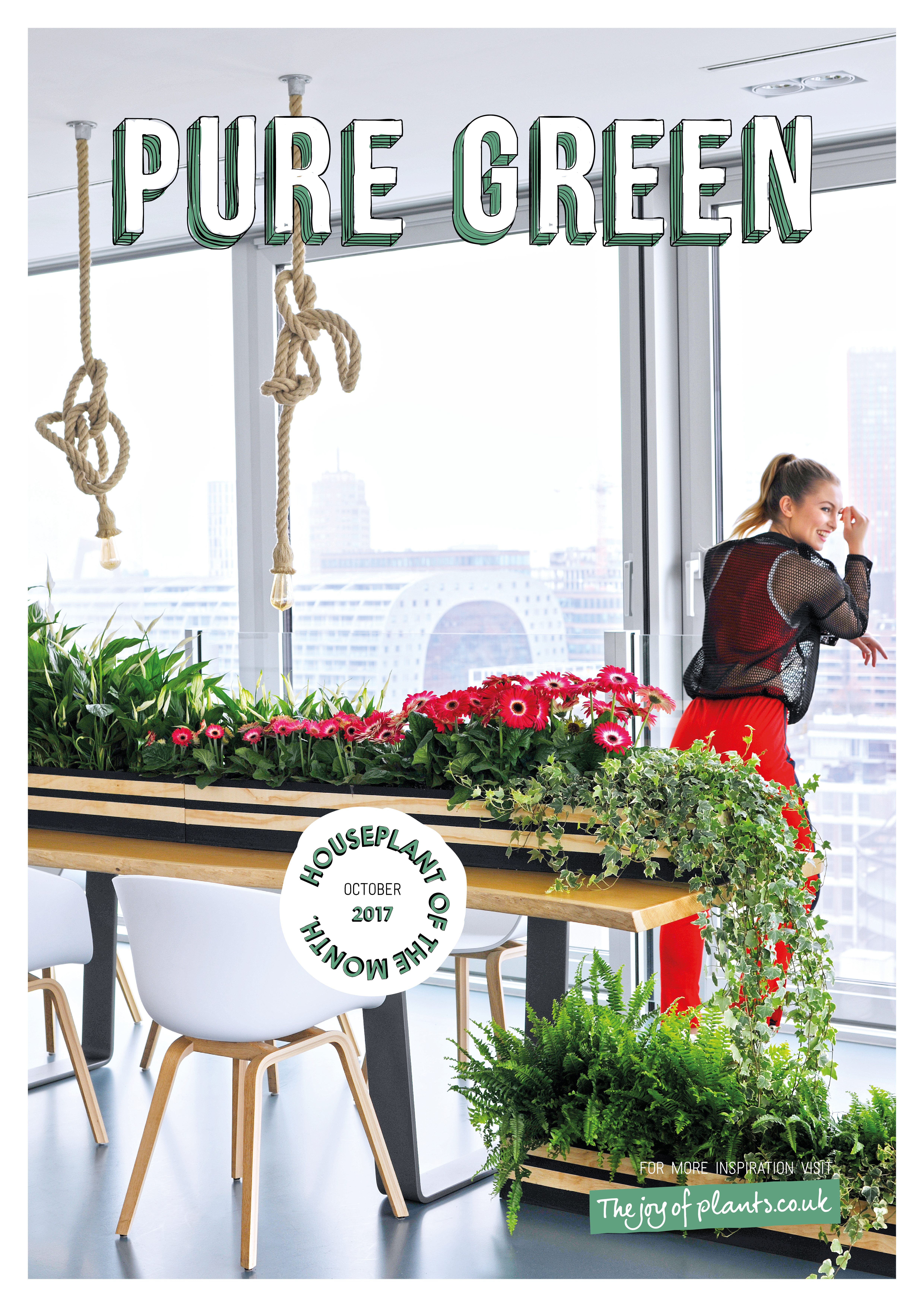
Gerbera flowers in Southern Africa, Asia, South America and Tasmania. This flowering plant is now available in 600 different colours, shapes and sizes. Gerbera is known as a cut flower, but it is the plant that can best absorb harmful substances from the environment. 
Nephrolepis Is a member of the fern family: beautiful foliage plants with very varied appearances which have been growing on Earth since the Devonian period (400-350 million years ago). Nephrolepis occurs in tropical rainforests around the globe. This bushy plant with feathered leaves is one of the best air purifying plants for the home.
Spathiphyllum comes from the tropical rainforests of Colombia and Venezuela, and is the sort of plant that everyone falls in love with straightaway: soft green leaves, white bracts around a flowering spike, and very interactive. If Spathiphyllum is too dry, its leaves droop in order to spring back up again within a couple of hours of being watered. 
What to look for when buying Pure Green 
  • With all the plants you should look at the pot size, diameter, thickness and height of the plant. With ivy it’s worth checking the length of the tendrils, and with Gerbera and Spathiphyllum you should check the number of flowers per plant and the stage of ripeness. 
  • All Pure Green plants should have slightly damp soil. The smaller pot sizes in particular dry out rapidly and then suffer leaf drop, shrivel leaves or dry leaf edges. 
  • Plants should be free of yellow leaves in the heart of the plant, particularly in winter. It's also a good idea to check for various types of scale insects and mealybug. Ivy can also suffer from red spider mite. These pests are often difficult to eradicate in the retail chain or at the consumer, so it’s advisable not to buy the plant.
  • Plants are often sleeved in order to protect them from cold or during shipping. Check that the sleeves are perforated because of the damp that can cause the Botrytis fungus. This grey mould can rapidly infest the plant.
  • During shipping and storage the temperature must be at least 12-15 °C or higher for Spathiphyllum and Nephrolepis. Ivy and Gerbera can tolerate lower temperatures.
Choice of range 

The range of plants with air-purifying properties is large. There are multiple cultivars available of each species:
Ivy offers a wide range of leaf shapes and colours. There are climbing and hanging forms, and many applications are created with it on arches, spheres, pyramids etc. The leaf colour ranges from smooth green through to variegated and marbled, and there is also a wide variety of leaf sizes. Cultivars such as Eva, Kolibri, Pittsburgh, Shamrock and Wonder are very popular. 
Gerbera occurs in many different sizes and forms, and is increasingly popular as a patio plant for use in the spring and summer. There is even a hardy variety (Garvinea).  For use the home there are a number of series that are offered in many colours, such as Durora, Fiori Line, Sundayz and Revolution.
Nephrolepis is by far the most important species within the ferns, with the cultivars Bostoniensis (often called Boston Fern) and Green Lady (narrow leaf) as the best known varieties. But Corditas, Duffii, Emina and Vitale are also attractive ferns with the same air-purifying properties.
Spathiphyllum is available in many sizes, always with a white inflorescence. The leaves are usually green, although there are also a couple with variegated leaves, such as S. Silver Cupido or S. Gimini. Many cultivars are named after composers: Chopin, Figaro, Vivaldi or Bellini. There are now many varieties of Cupido available.  

Care tips for consumers 
All Pure Green Plants should be wrapped carefully for the journey home during the cold months. 
Ivy likes a cool and light spot, but not in bright sunlight. The lighter the leaf, the more light it requires. The more chlorophyll, the less light it needs. The soil should not be allowed to dry out, but nor should the roots be standing in water. Give some plant food once a fortnight, place the plant under the shower from time to time or treat it to a session with the plant spray. Remove old leaves, cut back scrawny tendrils. Ivy cannot tolerate dry air well; this can lead to red spider mite. So don’t place it over a heater.

Gerbera prefers a light spot. The soil should not be allowed to dry out. Give plant food once every three weeks to ensure long, lavish flowering. Carefully remove exhausted flowers with a twisting movement from the heart so that the entire stem comes free. 

Nephrolepis prefers a spot where the temperature is above 12°C, between partial shade and light. The plant can’t tolerate direct sunlight or the dry air over a heater. Do not allow the soil to dry out. Water onto the soil in order to protect the heart of the plant. Rainwater is preferable - ferns cannot cope well with lime and salt. Give the plants some plant food once every 3-4 weeks during the growing season. 
Spathiphyllum prefers a light spot where the temperature is at least 12°C , but does not cope well with full sun. Do not allow the soil to dry out. The plant will show when it’s short of water by drooping. Spray the leaves regularly with tepid water, give some plant food once a month, remove wilted flowers. 

Thank you to Flower Council of Holland for the information and Thejoyofplants.co.uk. for the photos.

If you would like to purchase any of these plants we can get them all in when available from our suppliers.

Sandra x

HousePlant of the month - Pure Green - October


October 2017: Pure Green Houseplants of the Month 


The story of Pure Green 
Pure Green is about plants with air-purifying qualities which greatly improve their surroundings. Research by NASA has proved it: some plants absorb harmful substances and carry them away with their roots. They also release oxygen and help maintain the humidity level in the home. The Houseplants of the Month for October are the stars amongst the Natural Air Purifiers: Spathiphyllum, Gerbera, Nephrolepis and ivy. 
To have a real effect, NASA recommends at least 1 plant (pot size 15/20 cm) per 10 m². The amount of soil is also important, because micro-organisms in the soil absorbs small quantities of air pollutants. Pure Green plants are not only ideal for use in the home, but also in offices and schools.
Origin
Ivy (Hedera) is a member of the Araliaceae family, and grows on rocks and trees in Asia, Europe and North Africa. The plant is able to climb to a height of 25-30 metres and does particularly well in cooler regions. The Latin name ‘Hedera’ roughly means ‘gripping’ and refers to the roots with which the plant secures itself. Ivy symbolises eternal life, because the plant is evergreen. 
Gerbera flowers in Southern Africa, Asia, South America and Tasmania. This flowering plant is now available in 600 different colours, shapes and sizes. Gerbera is known as a cut flower, but it is the plant that can best absorb harmful substances from the environment. 
Nephrolepis Is a member of the fern family: beautiful foliage plants with very varied appearances which have been growing on Earth since the Devonian period (400-350 million years ago). Nephrolepis occurs in tropical rainforests around the globe. This bushy plant with feathered leaves is one of the best air purifying plants for the home.
Spathiphyllum comes from the tropical rainforests of Colombia and Venezuela, and is the sort of plant that everyone falls in love with straightaway: soft green leaves, white bracts around a flowering spike, and very interactive. If Spathiphyllum is too dry, its leaves droop in order to spring back up again within a couple of hours of being watered. 
What to look for when buying Pure Green 
  • With all the plants you should look at the pot size, diameter, thickness and height of the plant. With ivy it’s worth checking the length of the tendrils, and with Gerbera and Spathiphyllum you should check the number of flowers per plant and the stage of ripeness. 
  • All Pure Green plants should have slightly damp soil. The smaller pot sizes in particular dry out rapidly and then suffer leaf drop, shrivel leaves or dry leaf edges. 
  • Plants should be free of yellow leaves in the heart of the plant, particularly in winter. It's also a good idea to check for various types of scale insects and mealybug. Ivy can also suffer from red spider mite. These pests are often difficult to eradicate in the retail chain or at the consumer, so it’s advisable not to buy the plant.
  • Plants are often sleeved in order to protect them from cold or during shipping. Check that the sleeves are perforated because of the damp that can cause the Botrytis fungus. This grey mould can rapidly infest the plant.
  • During shipping and storage the temperature must be at least 12-15 °C or higher for Spathiphyllum and Nephrolepis. Ivy and Gerbera can tolerate lower temperatures.
Choice of range 
The range of plants with air-purifying properties is large. There are multiple cultivars available of each species:
Ivy offers a wide range of leaf shapes and colours. There are climbing and hanging forms, and many applications are created with it on arches, spheres, pyramids etc. The leaf colour ranges from smooth green through to variegated and marbled, and there is also a wide variety of leaf sizes. Cultivars such as Eva, Kolibri, Pittsburgh, Shamrock and Wonder are very popular. 
Gerbera occurs in many different sizes and forms, and is increasingly popular as a patio plant for use in the spring and summer. There is even a hardy variety (Garvinea).  For use the home there are a number of series that are offered in many colours, such as Durora, Fiori Line, Sundayz and Revolution.
Nephrolepis is by far the most important species within the ferns, with the cultivars Bostoniensis (often called Boston Fern) and Green Lady (narrow leaf) as the best known varieties. But Corditas, Duffii, Emina and Vitale are also attractive ferns with the same air-purifying properties.
Spathiphyllum is available in many sizes, always with a white inflorescence. The leaves are usually green, although there are also a couple with variegated leaves, such as S. Silver Cupido or S. Gimini. Many cultivars are named after composers: Chopin, Figaro, Vivaldi or Bellini. There are now many varieties of Cupido available.  
Care tips for consumers 
All Pure Green Plants should be wrapped carefully for the journey home during the cold months. 
Ivy likes a cool and light spot, but not in bright sunlight. The lighter the leaf, the more light it requires. The more chlorophyll, the less light it needs. The soil should not be allowed to dry out, but nor should the roots be standing in water. Give some plant food once a fortnight, place the plant under the shower from time to time or treat it to a session with the plant spray. Remove old leaves, cut back scrawny tendrils. Ivy cannot tolerate dry air well; this can lead to red spider mite. So don’t place it over a heater.
Gerbera prefers a light spot. The soil should not be allowed to dry out. Give plant food once every three weeks to ensure long, lavish flowering. Carefully remove exhausted flowers with a twisting movement from the heart so that the entire stem comes free. 
Nephrolepis prefers a spot where the temperature is above 12°C, between partial shade and light. The plant can’t tolerate direct sunlight or the dry air over a heater. Do not allow the soil to dry out. Water onto the soil in order to protect the heart of the plant. Rainwater is preferable - ferns cannot cope well with lime and salt. Give the plants some plant food once every 3-4 weeks during the growing season. 
Spathiphyllum prefers a light spot where the temperature is at least 12°C , but does not cope well with full sun. Do not allow the soil to dry out. The plant will show when it’s short of water by drooping. Spray the leaves regularly with tepid water, give some plant food once a month, remove wilted flowers.
With thanks to https://www.flowercouncil.co.uk for all information

These plants fit in well with the Pantone colour of the year 'Greenery'. Choose these plants as part of your wedding displays. Use foliage such as ferns and ivy in your bouquets and buttonholes and for the tables make groups of plants your centrepieces. Display on log slices or small logs with moss to really set them off. These could then be given away as gifts for your guests to have a lasting remembrance of your day.

To discuss how we could style this look for you, get in touch to book a consultation today.

Sandra x